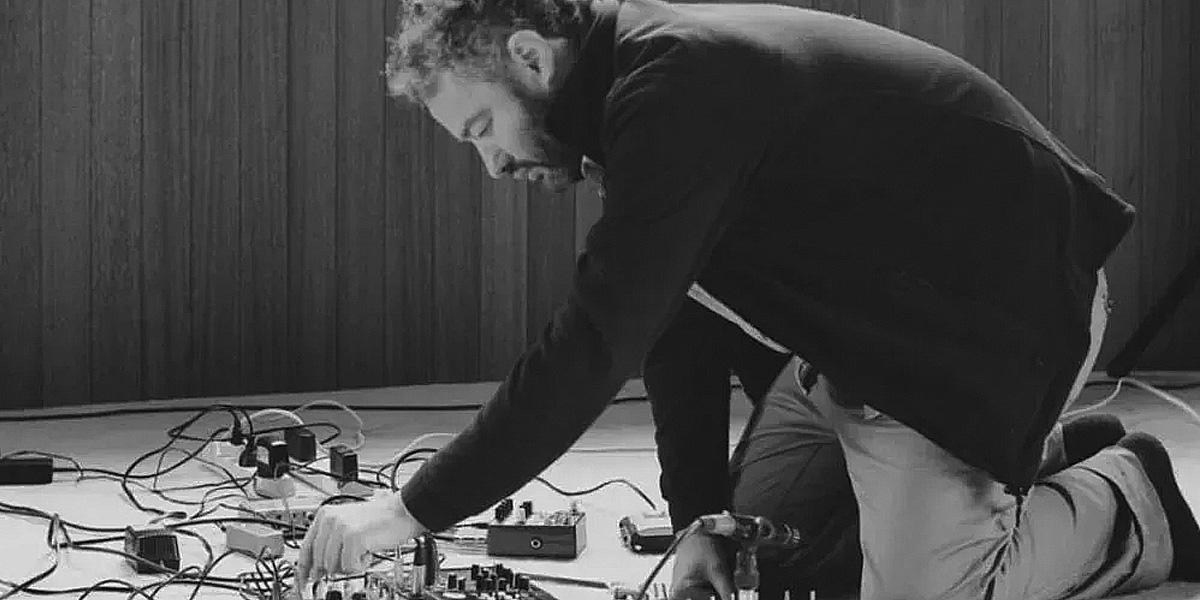
Federico Durand: Índice interview.
TOYS FOR GROWN-UPS: FEDERICO DURAND
Ten years after his first appearance in this section, Federico Durand returns to “Toys for Grown-Ups,” generously sharing the role that cassette recorders play in his compositional process.
Artist: Federico Durand
Item: Sony TCM 200-DV recorder.
Federico Durand
- Last winter, I met up with Sara and Jairo at the La Tortuguita bar in Montevideo. That Sunday morning, the Tristán Narvaja market was at its brightest. A bustling crowd moved back and forth among the stalls selling fruit, antiques, and street food. As I wandered about in search of a treasure—a ceramic figurine, a record, a book—Jairo invited me to write about a musical instrument, just as I had done ten years earlier. Back then, I wrote about my pentatonic lyre—an Auris lyre I’d discovered in a toy shop in Tübingen that looked like it had come straight out of a fairy tale. This time, I’ll tell you about my Sony TCM 200-DV recorder.
Sony TCM 200-DV
“IT’S A PLEASURE TO HUNT FOR CASSETTES IN SECOND-HAND SHOPS AND AT MARKETS LIKE TRISTÁN NARVAJA. USING CASSETTES AS MUSICAL INSTRUMENTS CONNECTS US TO A CRAFT-BASED DIMENSION. CREATING LOOPS REQUIRES A RULER, ADHESIVE TAPE, A SCREWDRIVER, AND SCISSORS. EVERY CASSETTE TELLS A STORY.”
- The Sony TCM 200-DV recorder is one of my favorite instruments. Here is a list of its key features:
It’s small—it fits in a coat pocket—and it runs on batteries. I’ve taken it along on all my musical journeys and even on a few family vacations. Back in the 90s, when I first discovered it, many people used it to record classes or interviews. It’s perfect for recording onto fresh cassettes—or, better yet, onto worn-out tapes found on the street.
It offers plenty of room for manipulation: a pitch wheel allows you to fine-tune loops and recordings. It features a built-in speaker and microphone that enhance its lo-fi character. The “pause” function creates a sliding effect—the tape slips and comes to a halt. There’s also a switch to drop the pitch by an octave, making the sound slower, duller, and deeper. While these features were originally designed to optimize tape duration and recording quality, they serve as excellent aesthetic tools for studio sessions and live performances.
I have an emotional connection to this model; I’ve been using it for many years. Anyone who has attended my concerts will know that it’s a regular part of my instrument setup. I couldn’t even say how many Sony TCM 200-DV recorders I’ve owned—I’m constantly on the lookout for more, as they tend to fall apart in my hands from all the handling.
Recorders in good condition are becoming increasingly rare. By sharing this, I invite you to seek one out and incorporate it into your own musical practice. Beauty is meant to be shared.
There’s a certain pleasure in hunting for cassettes at second-hand shops or markets like Tristán Narvaja. Using cassettes as musical instruments connects us to a more tactile, artisanal dimension. Creating loops requires a ruler, adhesive tape, a screwdriver, and a pair of scissors. Every cassette tells a story—there are old local brands, like Audi or Profesional, and imports like Crown or TDK. Some are standard, while others are higher quality—chrome or metal tapes. Sometimes, you’ll even find the previous owner’s name written on them in cursive. Echoes of the past. Ghostly voices. Over time, you develop a personal bond with certain cassettes, using them again and again. Sound recorded on tape possesses a mysterious quality—like a forest veiled in mist—a form of beauty absent from the purely digital realm. When my daughter, Luisa, was a baby, she would sleep between my wife and me. I kept my cassette recorder under my pillow, always ready to capture her early vocalizations—sounds that were neither articulated language nor music, yet resembled both. It remains one of my most cherished recordings.
- Below, I share the instructions for a piece I created to be performed using my tape recorder. It is titled “Tape.”
Take an answering-machine cassette—a 30- or 45-second loop—and insert it into a portable tape recorder.
Go to a dark, quiet spot in your home. Pay attention to the ambient sounds: the murmur from the street, the creaking of the wooden floor. Reflect on the beam of light filtering through the window blinds.
Place a harp, a lyre, or another stringed instrument next to the recorder. Begin recording. Pluck the strings slowly, one note at a time.
Stop the recording.
Connect the recorder to a small audio mixer, which in turn is linked to a chain of effects pedals.
Arrange the sounds in a circle, like beads on a necklace made of pasta. Hide a pearl—or a single drop of dew—somewhere among them.
Let the music go wherever it chooses.